Wednesday, November 21, 2007

Art? Part VII: Why is this crap hanging in a museum?

A multi-part essay on Art and what I think about it.


So far we’ve been spending a lot of time looking at Art that’s considered controversial. Now we’ll question its value. If we concede that it is indeed Art because it was made with intent and is an interpretation of the artist’s universe, do we also have to agree that it belongs on the wall of my local art haus?

Nope!

“Really?” you ask. “I actually have some say in whether the so-called Art I’m looking at is crap or not?”

Yup!

“So why is that crap hanging in my museum then?”

More to the point is how the determination is made whether a work of Art is good, who gets to decide, and if that label is permanent.


The Ronco Goodness Scale™

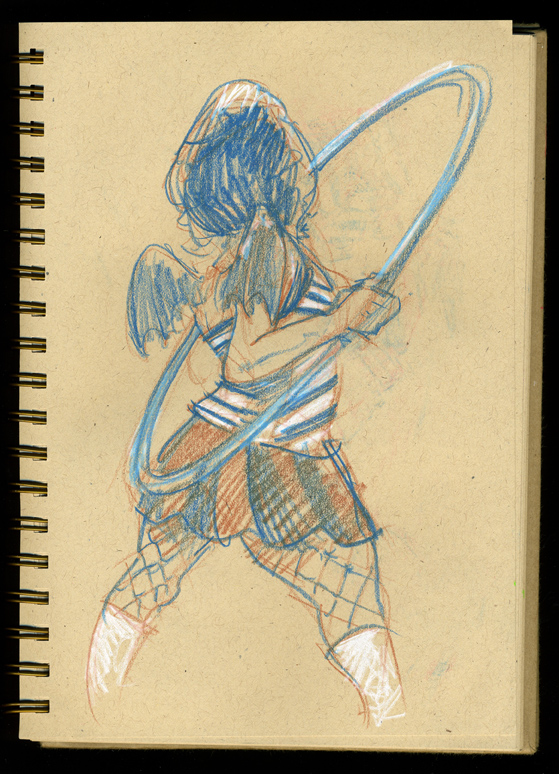
Once a month a group of Metro Detroit artists gather in a smoke filled bar in the hamlet of Hamtramck for a session of figure drawing called Dr. Sketchy. Models are culled from the local burlesque scene and we all pull out our pencils or whatever and do our best to capture the action in front of us. As an artist I am occasionally happy with my results and might proclaim a particular drawing my best from that night. To me it’s a good representation of what I see jiggling in front of me. So I call it good. And John sitting next to me might lean over and say, “Hey, that is good!” So it must be good right? But I might lean back over John’s sketchbook and say, “Maybe mine’s good, but I like yours better! It’s awesome!” Suddenly my drawing’s not so good as it was a moment ago.

If I flip back through my sketchbook and compare my sketch to others I’ve done in the past, it might lose even more standing on the “good” scale. It’s not that good at all now, is it? Then the Swag Faerie bypasses my “work of Art” as well as John’s and picks someone else’s to win a prize bag full of goodies. What the hell just happened? I thought mine was good? Apparently not.

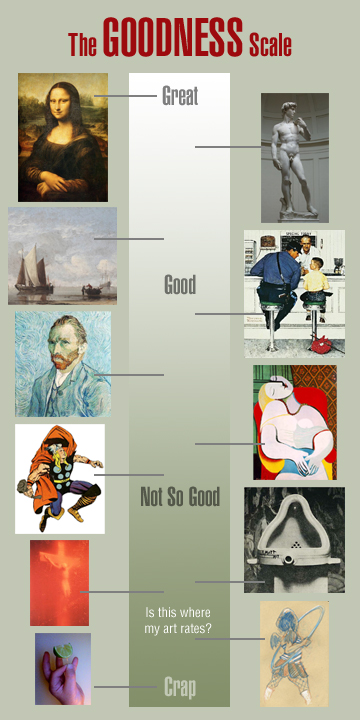
It looks like our idea of what’s good is in comparison to other Art that’s out there for us to see. So, does that mean there is some scale to look at where Art is rated? One where the Mona Lisa sits at the top and where sticks with limes stuck on them are at the bottom? Where does something like Marcel Duchamp’s Fountain fall?
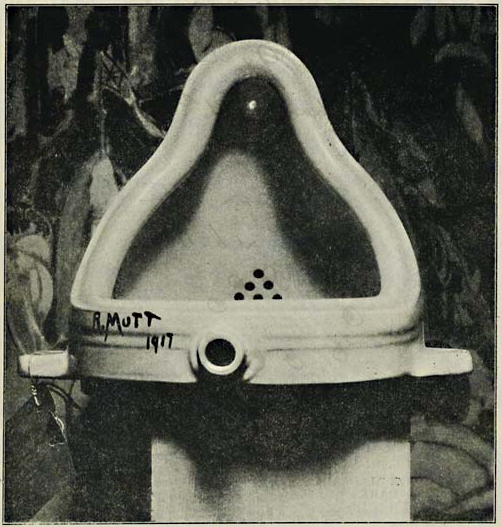
Fountain, Marcel Duchamp, 1917


Above or below my work? Near the bottom though for sure, right? But why was his urinal voted the most influential artwork of the 20th century by 500 British Art professionals? Were they all full of it? Do I have to pull my scale out and compare my now apparently shitty Art with all other Art to determine whether it should just be tossed into the trash? Does that scale even matter?

Heck no.

It all depends on what situation in which we’re looking at the Art and by what criteria we judge its goodness. As music goes the Mona Lisa is crap.


“Wait,...what? Why would we even think to place the constraints of what makes good music upon a painting?!”

“Why?” indeed. I don't expect the Mona Lisa to offer me anything in the way of musical entertainment. Likewise, why would I compare my sketch of a hula-hooping zombie cheerleader to the Mona Lisa when all I want to know is how good it is in comparison to other work I’ve done?
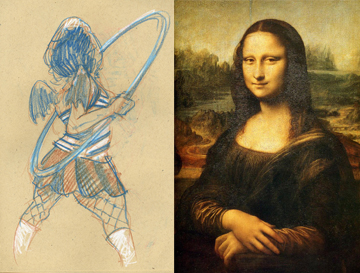


Hula-hooping Zombie Cheerleader, James Anderson, 2007
La Gioconda, Leonardo da Vinci, c. 1503-1506


A work of Art can only be rated good or bad by what we expect out of it. It’s highly subjective. Remember that the next time your young niece asks you if you think the picture she made for you is good.
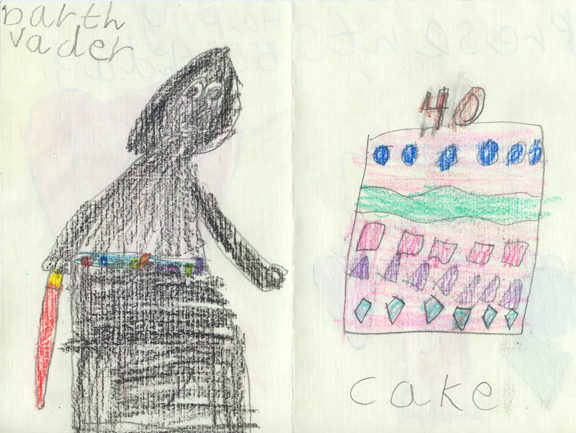
Darth Vader and Birthday Cake, Alison Gruchala, 2006


So we ask, when confronted with Art we don’t like, “Why does anyone consider things like this to be good?” Well, why do people like Impressionist paintings? Back in the latter half of the 19th century Impressionism was thought of as a plague on the Art world. How dare these...these...Bohemians try to pass this crap off as Art? It all has to do with the intent of the artist again.
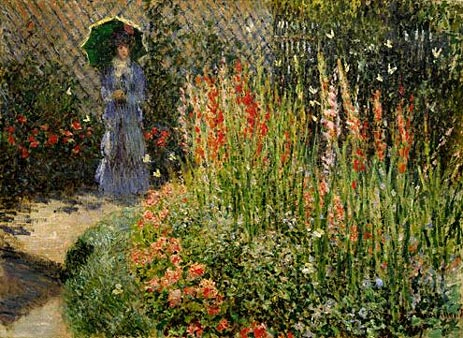
Gladioli, Claude Monet, c. 1876


The intention of Impressionist paintings was not to strive to be like the academic paintings of the period that came before. As the name of the movement implies (which was only coined at a later date) the artists were attempting to capture the impression of light in nature - light that quickly changes. Eventually a number of Art critics began to appreciate what those wacky Impressionists were trying to say and concluded, “Hey, this is pretty good stuff. You should have a look!” And only then did Art museums begin hanging them on their walls.


Working in the Abstract

Again, it all depends on what an artist wants their work of Art to do. Art that tends more toward the abstract, like Scream by Edvard Munch, may not contain all of the information that say The Raft of the Medusa by Gericault contains. The Raft of the Medusa is like a novel, conveying to you not only the action in the scene, but also the shape and form of the figures as well as evoking feelings through the use of symbolism.
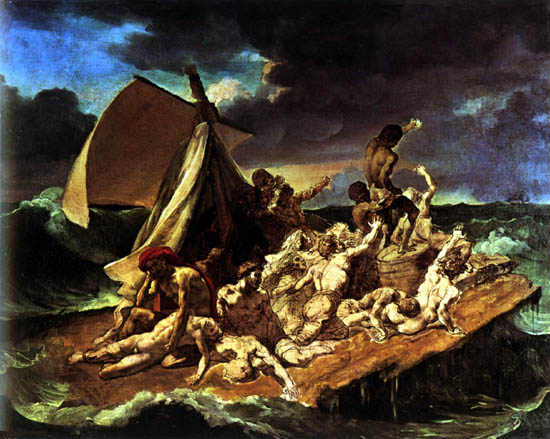

The Raft of the Medusa, Théodore Géricault, 1819
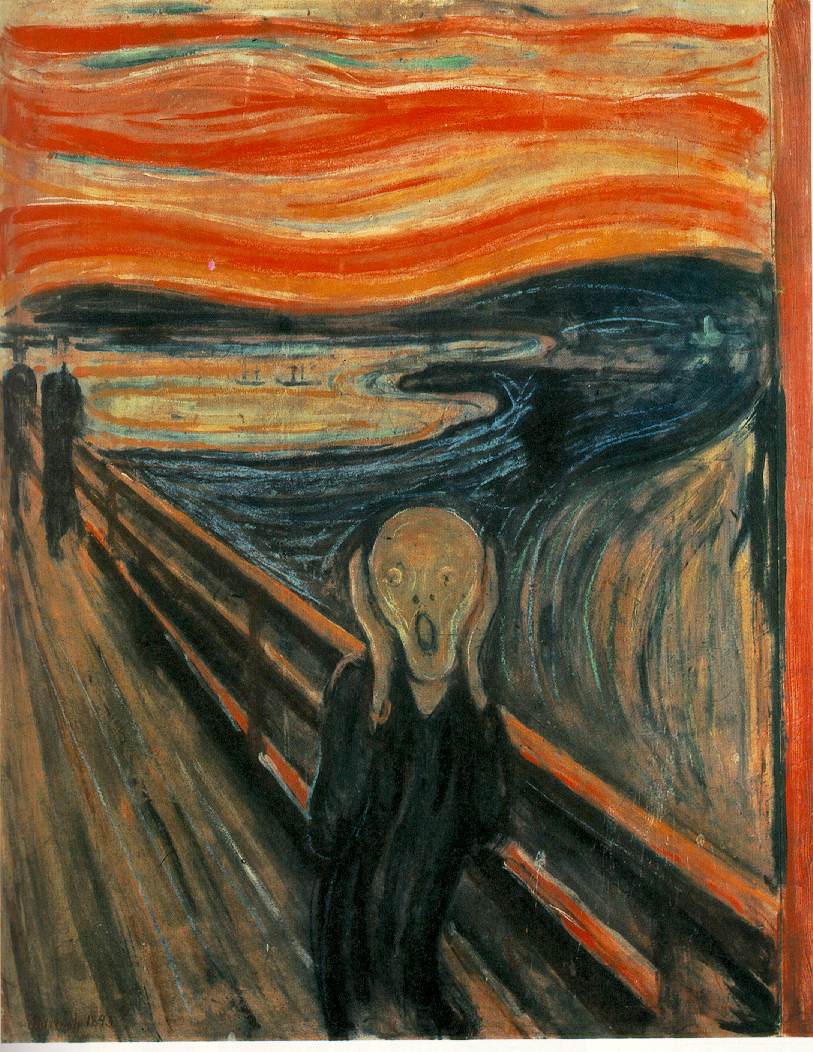

Scream, Edvard Munch, 1893

Scream is not concerned with all of that. It’s like a short story. It just wants to get one point across - the feeling of anguish that makes us want to scream - and it does it pretty well. That’s why it’s hanging in a museum, not because someone wants to “trick” us into liking crap. Munch didn’t paint it because he wanted to get rich quick. He painted it because he was trying to say something. Same for that pee-cross.

“But doesn’t the amount of work that goes into a work of Art add value to it?” Only if that’s what we expect from it. Duchamp submitted his toilet “ready-made.” No work went into it at all other than the brainpower used to bestow a meaning on it and a signature that wasn’t even his own name. But Fountain was picked as the most influential artwork of the 20th century anyway. So go figure.

Also, the amount of work involved in a work of Art isn’t always apparent so it’s difficult at best to use that as a measure of any universal goodness. Even though you might say that thousands of hours went into painting The Raft of the Medusa, thousands might have gone into painting Scream as well. You just don’t know that those thousands of hours were spent practicing on other paintings and trying to whittle the extraneous stuff down to what was only necessary to portray that feeling Scream evokes. Heck, some of those thousands of hours were probably spent in “research” - standing around screaming in anguish - so Munch might be highly qualified to try and capture that feeling in paint.


Artistic Environmentalism

It’s not only what a work of Art is trying to do that causes us to put a label of good or bad on it. It also depends on what environment the work of Art is viewed in.
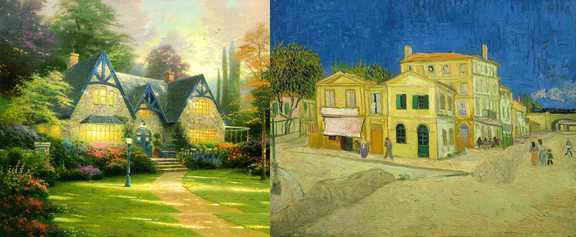

Windsor Manor, Thomas Kinkade, 1996
The Yellow House, Vincent van Gogh, 1888


I can place Vincent van Gogh’s The Yellow House next to a painting by popular artist Thomas Kinkade called Windsor Manor. Most educated individuals would pick the one-eared wonder over the commercial hack any day for many reasons. (Myself included.) But it’s an opinion based on what we expect from our paintings. And the word educated is the key. We only pick Vincent’s work because we know things about each of the paintings and make a choice about those things we deem more important to us. But what’s important to me isn’t necessarily important to everyone. That’s why there aren’t only tours to visit van Gogh’s birthplace in the Netherlands, but at Kinkade’s as well in swanky Placerville, California.

If we were to take both paintings by van Gogh and Kinkade and bury them in the sand for thousands of years until all reference to them had been forgotten, what might the people who unearth them conclude? Kinkade’s colorful houses might be more representative of something those people will understand. Based on the draftsmanship alone Kinkade could be considered the better artist. And he is the “Painter of Light” after all. Van Gogh’s buildings tend to be out of whack and out of correct perspective. He sometimes doesn’t even cover the complete canvass with paint. He’s sloppy. Kinkade’s got him beat as far as future archeologists and art critics might one day be concerned. So it all depends under what circumstances we judge Art.


Criticizing the Critics

That still doesn’t answer the question as to why we find things like urinals in museums - aside from the ones in the bathrooms. “Why do these Art critics, these elitist snobs, get to decide what goes on the walls of my government buildings?” Because we want them to.

Not that we want urinals as Art per se, but because there’s so much Art out there to wade through that we leave it to other people to conclude that some work of Art has enough value that it should be included in a museum’s collection. And occasionally that collection will include things that you personally just don’t like very much. Or things you don’t have any interest in understanding. Or things that you think should be used to stoke the museum’s furnace. It’s bound to happen. That’s fine. We don’t have all the same likes and dislikes. That’s one reason I don’t spend a lot of time in the Modern Art section of the Detroit Institute of Arts. I’d rather be looking at Impressionist paintings. But every once in a while I peek in and maybe learn something new.

It’s an Original!

As for Duchamp’s urinal, well...one thing we value in our Art above all is originality. The saying goes that there’s nothing new under the sun. Every once in a while, though, somebody comes up with a way of saying something with their Art that isn’t quite like anything else.

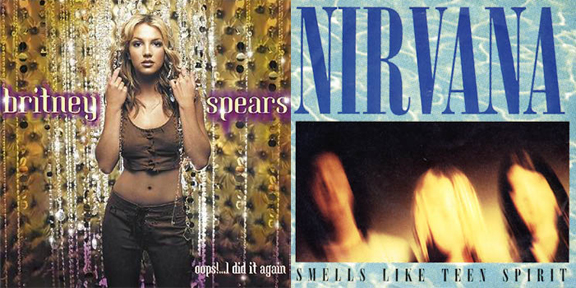
Using music as an example of originality, we all have favorite musicians that we like, but our group taste tends to recognize those who take a musical style in a new direction. Britney Spears may have had excellently produced CDs, but when it comes to originality, her music really offered little that was new or innovative. She may have been extremely popular and gotten kudos from the kids, but she doesn’t have universal appeal.


Conversely, Nirvana’s Smells Like Teen Spirit launched the rock movement dubbed Grunge upon the world. These guys were doing something we’ve never heard before; and, though it took time to catch on, their music influenced an entire new generation of musicians. Still, they don’t have universal appeal either. Ask your parents to listen to Kurt Cobain and his gang and they’re likely to tell you to turn down the noise.

Getting back to the categories of Art that end up in museums, usually the painting or sculpture types, they scream out for originality. And because the main function of museums along with the preservation of Art is to educate, it only stands to reason that they want to show us the best and most varied examples of Art available.

So after our trip to the museum or the rock concert, it’s now left to us to continue with our educations, to fill in the gaps. We usually fill in those gaps with other fine examples of work that, for whatever reason, appeals to us. On rare occasions we take a leap of faith and look into something we have no previous experience with. Sometimes we find nothing that appeals to our sensibilities, but other times we’re smacked betwixt the eyes and it opens up a whole new world for us. And we just might call it “good”. And for each of us, we’d be right.
Next time: Beauty’s in the eye of the beholder

Art? Part VI: Function Junction

A multi-part essay on Art and what I think about it.


Can anyone really look at a photo of a cup of urine with a crucifix in it and say it’s beautiful? Isn’t that what Art is supposed to evoke in us? A sense of beauty? I don’t know if it’s beautiful, but that all depends on whether Serrano meant for it to portray beauty in the first place.

When he gave it meaning with some intention, he gave it a job to do. That job might not necessarily have been to entice you to say, “That is the most beautiful photo of a pee soaked cross I’ve ever laid eyes on. And look at the lovely amber color of the urine! Where can I buy a print?” The function of Art isn’t always about what makes a pretty picture.

Since all Art is about intent, an artist might have several different functions in mind for her work to do. It can illicit some kind of emotional response such as happiness, sadness, or disgust in the case of the previously mentioned pee on Jesus. It might be trying to make a point or be representing an idea like that volcano painting or the red ping pong table. It may support someone else’s idea like a magazine or book illustration. Its purpose could be to entertain either an audience or the artist themselves. It can intend to be an inspiration for other art or an example of a genre. It can even be a means to gain approval or love, like the crayon drawings we plaster all over the fridge that we get from kids. And, of course, maybe the artist just made something to look pretty. The possibilities are endless!

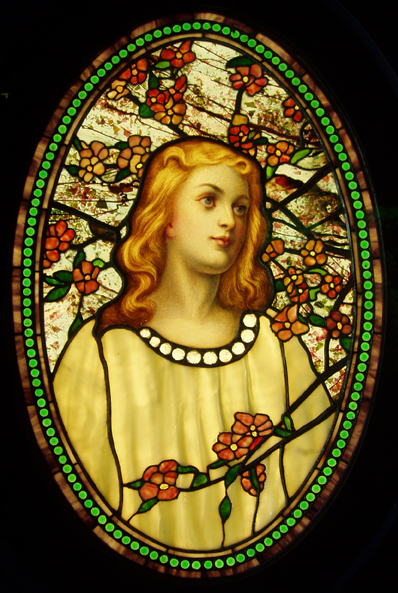
How do we know the job the Art is supposed to be doing? Well, like the meaning of the painting it can come from the artist themselves. But also like the meaning, we may perceive it as being within the Art itself. We can look at a Tiffany stained glass window and probably get some kind of clue as to the job it’s to do. Maybe we get a sense of beauty from it. That’s its job, or at least one of the jobs the window is supposed to perform, as far as we can tell.

Girl with Cherry Blossoms , Louis Comfort Tiffany, c. 1890

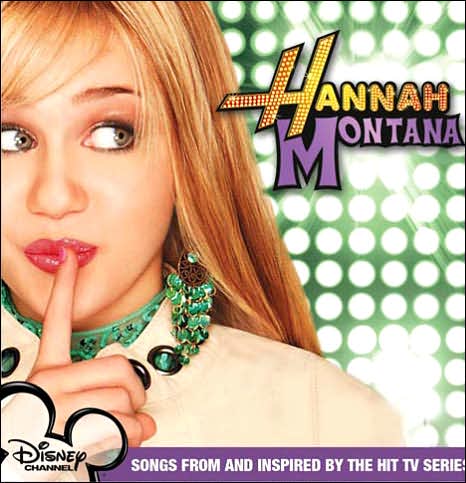
We might not even know the job that the Art is supposed to be doing. This might be an accident when the artist hasn’t made his intentions clear and we miss something, or the work is misinterpreted. These things may alter the value we place upon the work. But sometimes the job might be to target a specific audience. You might not like Hannah Montana, but that might be because her music isn’t meant for you.


Her artistic endeavors function to appeal to thirteen year old girls and sell CDs to them. And if you’re a parent of one of them, you’ll likely be ultimately exposed to Ms. Montana’s music anyway when you play chaperone to half a dozen of your daughter’s screaming friends at her concert.

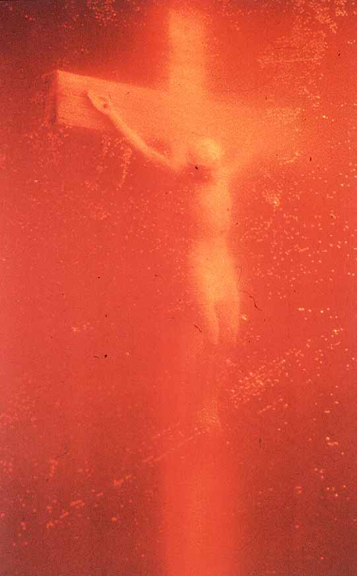
But what about the photo of the pee-cross? Surely its function is not to elicit gasps of adoration. Perhaps it’s meant to irritate or even outrage the viewer. And, like Hannah Montana, it’s probably directed at a particular audience. Hindus may be likely to find something appalling if it concerns urine being used as part of an art object, but won’t be personally offended like Christians are likely to be. Or the Catholic Church. But an understanding of something so controversial can come from the unlikeliest of places. Sister Wendy Beckett, the Art nun, voiced her approval of Piss Christ. She regarded the work as a statement on “what we have done to Christ.”

Just because it has a job to do, or someone approves of it, does that necessarily mean it has value? You may think its crap, but can it be appreciated for what it’s trying to do? Does it have any worth? Is it, dare I ask, any good?
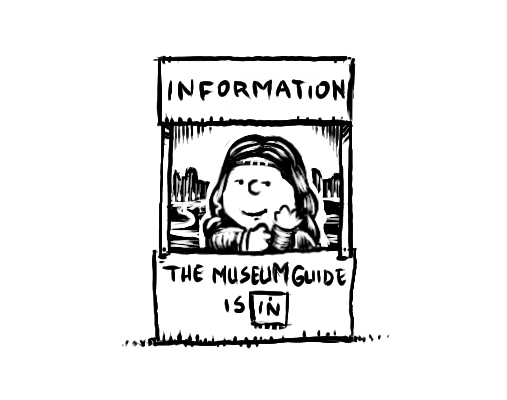
Next time: Why Is This Crap Hanging In A Museum?

Tuesday, November 20, 2007

Art? Part V: Information Desk

A multi-part essay on Art and what I think about it.


Just what did Barnett Newman intend when he painted Be I back in 1970? How can we know what those intentions are, what his painting is supposedly about, if its meaning doesn’t immediately smack us in the face when we see it? Can we only consider some work a piece of Art if it doesn’t require us to read a novel to understand it?

As I explained earlier, it doesn’t matter how far away a work is from reality that determines whether or not it’s Art. The distinction is blurry and wearing artsy reading glasses won’t help you see it any clearer. So when things become less clear we often need an explanation to help us along, because we can’t read the mind of the artist. Especially if he’s dead.

When I show you a painting like Cotopaxi by Frederic Church there is a certain amount of information that we can get out of it just by looking.

Cotopaxi, Frederic Church, 1862

First, it’s got lots of nature in it and we like nature. Sunsets are beautiful and Church paints a really nice one that’s colorful due to the smoke and ash from the erupting volcano - a volcano, which we assume, that is the focus of the painting. But how do we know that the volcano is the focus? It does appear to be the most prominent feature of the painting, but it isn’t in the exact center. Plus it also shares the canvas with that sunset, as well as a nice waterfall with a rainbow, and a little fellow with his pet llama.

Any of those things could be the actual subject of the painting. So how are we to know? Luckily Church gave us a little bit of extra info. In this case, the title: Cotopaxi. And if we know anything about South American vulcanism we would know that Cotopaxi is not just the name of a painting, it’s also the name of a rather large volcano in the Andes. So it’s about the volcano after all!


Or is it?

Just how much information does the artist have to give us before we know what the painting’s about? As much as it takes apparently. Art is somewhat like a language, each work a different dialect. If we don’t understand the language we might need a translation to help us out. So if I’m speaking French to you and you only understand English, I need to tell you what I mean when I say, “Cotopaxi est le commentaire de Church sur la tragédie de la guerre civile américaine. “But just because you don’t understand what I’m saying doesn’t mean that French isn’t a language. Frederic Church does the same sort of translation work when he titles his painting Cotopaxi and tells us that it’s his commentary on the tragedy of the American Civil War. Now we understand. We may say he’s philosophizing, but that was his intention in painting his work of Art.

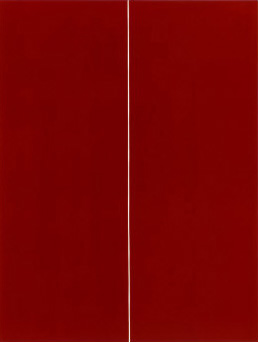
Likewise, Barnett Newman explains that Be I is about the existence of being. The red background represents earth and the white stripe, which he called a “zip”, suggests a moment in time. A flash. It may not be apparent at first viewing but now that we know we have a greater insight of what the artist meant to say. A greater insight into his interpretation of his universe. The more we study Art the more we can understand those artistic dialects. and we become the richer for this exchange of ideas.

If photographer Andres Serrano puts a cross into a vat of urine, photographs it, calls it Piss Christ, and then proceeds to give it meaning, that is his intent as the artist. So, believe it or not, that makes it Art.

Piss Christ, Andres Serrano, 1989

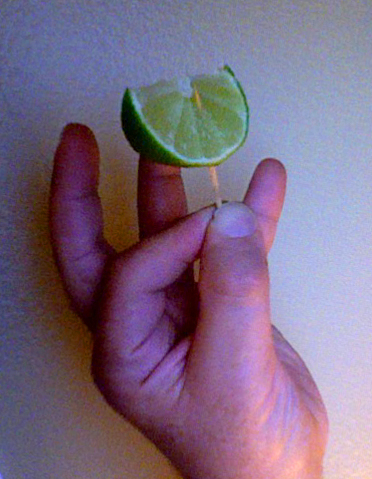
You might not like it, but that doesn’t change his intentions. The same goes for a lime wedge I stick on a toothpick and call it my statement on the vitamin C intake of barflies. It just became Art. Just now. And it’s Art by our definition. But how are you supposed to react to it?

Lime For Your Corona, James Anderson, 2007

Next time: Function Junction

Monday, November 19, 2007

Art? Part IV: What Intentions?

A multi-part essay on Art and what I think about it.

As stated previously, somebody might argue that for something to be Art it must be recognizable. The rock carved into the shape of David looks like a man. The song Still Haven’t Found What I’m Looking For by rockers U2 has a recognizable melody and follows rules set forth for pop music. The movie Dirty Dancing has a beginning, middle, and an ending where no one puts Baby in a corner. We understand these things.


But how anatomically correct does David have to be for us to recognize him as a man? Surely, pretty accurate, right? Depends. Take a look. Which of these below represents a man?

David, Michelangelo; Walking Man II, Alberto Giacometti, (1948) Bronze; Lascaux Cave drawing

Well, they all do. Obviously Michelangelo’s David is the most anatomically correct. But if we use that as the measure for what makes it a work of Art, even poor Dave fails that test.

How’s that? Well, as much as we can discern that Michelangelo’s statue of David is representative of a man, he’s far from anatomically correct. His head is out of proportion to his body, his hand is too large. For that matter his marble flesh isn’t even the right color, unless he’s an albino. How can he be considered a work of Art by these criteria any more than the other less anatomically correct figures in the pictures above?

He can’t. Where do you draw the line? How far away from reality can the work veer before we say it no longer represents a man? And when it’s at that point what does it then represent? Who can even know what the figure represents at any point? Only one person can.

The artist.


There’s a problem with foisting rules on somebody else’s creation before it can be labeled Art. We don’t always know what meaning the artist gives to his work when he creates something.

In the examples above, each figure clearly represents a human form. David is specifically representative of the hero from the Bible. Giacometti’s Walking Man II isn’t representative of anybody in particular, it’s that it’s a person striding forward that’s important. And in the Lascaux cave painting we can only surmise that the figure represents a man hanging with the birds and beasts, but whether he’s specifically meant to be Chaka the cave boy with his wiener hanging out or nobody in particular, isn’t known to us - because we don’t know the painter’s intentions.

The one thing that determines whether an object is a work of art or not is the intentions of the person making it.

A painting doesn’t exist on a graded scale that, once it reaches a point farthest from something else we like to call Art, can just be knocked off the shelf. There’s no sharp line that divides one piece of Art from another. It’s only the intentions of the sculptor or painter or composer that determines if what they create is Art. And we have to trust them when they tell us their intentions, the thing that gives their Art its meaning. Otherwise, how would we know if it’s their interpretation of their own universe?

Don’t believe it? Ask a painter what she thinks her painting is about. When she explains it to you try to tell her that she’s wrong. Really, she’s wrong? How can we know better than the artist what her Art is about?

So when Barnett Newman paints a flat red field on a canvas and places a white line neatly down the middle of it and calls it Art, we have to take his word for it because he knows his own intentions. It just helps a lot when we understand what those intentions are, too.

That doesn’t mean you have to like it though.


“If someone creates something and calls it art, then fine, (s)he is an artist. There’s no qualifications or degrees necessary for the title.”
John Nagridge , Yeah, but is it Art

Next time: Information Desk


Art? Part III: So. Art.

A multi-part essay on Art and what I think about it.

What exactly fits into the category I’m calling Art? We all have some idea of what is meant when we hear the word. Painting, sculpting, photography, music, filmmaking, dancing. What about cooking? Perhaps. Maybe even gardening? Hmmm. Lots to think about.

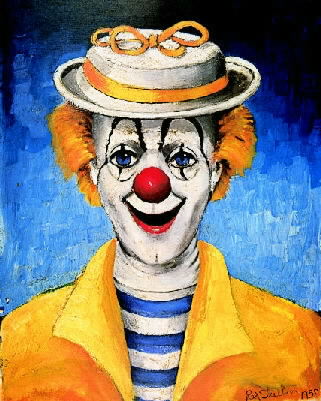
Before we know what fits under the big tent that encompasses the three-ring-circus that is Art, it helps to know what criteria are employed to determine what does or doesn’t fit, and why. For instance, “Is the Red Skelton painting of a clown that’s hanging in the cubicle of the nice lady across the aisle at the office really Art? Really? You’re kidding, right?”

So why don’t I just give up the definition right now and get it out of the way, okay? Here it is:

Art is an interpretation of one’s own universe.

That’s it. Sounds simple, doesn’t it? I can’t take credit for that elegant definition myself though. That one was offered up by my good friend John Nagridge back during the great Internet Art Wars. I had come up with one myself, but it’s far too clunky. By your furrowed brow I can see that you might be about to ask, “How’d you come by that?” Let’s take it step by step.

We come at the problem with the idea that some things definitely are Art, while other things certainly are not. But how do we know the difference between the two?

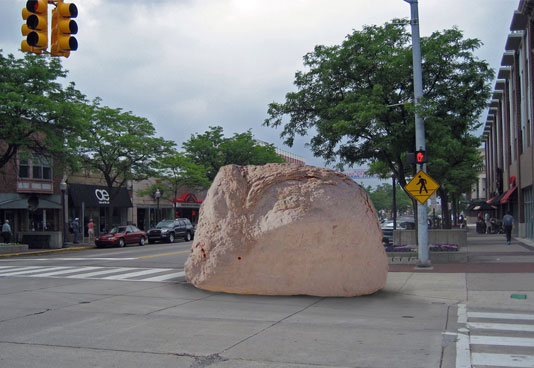
Let’s take something that we know isn’t Art at all. Say you’re walking along and you come across a big rock lying by the side of the road.


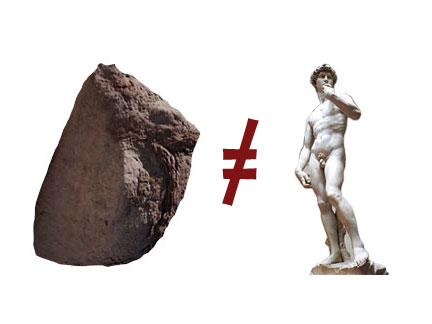
It doesn’t look like it’s been touched by human hands, and certainly hasn’t been bestowed with some deep meaningful title. We pull up the pick-up truck and have a couple of friends risk hernias to lift it into the back and haul it to our studio. Once there it is sculpted into the form of a young man holding a sling in heroic fashion.

David, Michelangelo, 1504

We title it David, so as to portray the Biblical figure who slew the giant Goliath with a rock to the noggin. This version of the rock we might safely label as Art.

What is the difference between the rock by the side of the road and the completed sculpture? Lots of things. Firstly, it’s been shaped into something recognizable, and purposely so. It has a title and has been endowed with some meaning - that the sculpted figure before us represents something that isn’t inherent in its form. By that I mean that the naked guy is supposed to be the David from the Bible story, but unless we know this information beforehand, there’s nothing within the sculpture that tells us this.

Are these differences the things that make it Art? Not necessarily. I’ve seen lots of so called Art out there that is labeled nothing more than Untitled. Having a title doesn’t appear to bestow any magical artistic quality upon our statue of David the Giant Killer. Is it that the Art be something recognizable? Maybe, but what if it’s representing something new that we’ve never experienced before? What does that leave us with? The meaning behind the Art? Why should I care what it means?

Next time: What Intentions?

Art? Part II: The Problem Word

A multi-part essay on Art and what I think about it.


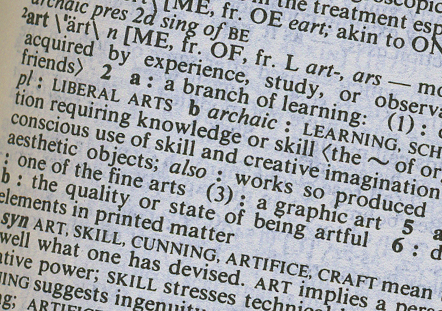
Language, being the amazing thing that it is, allows us to convey the ideas floating around in each of our heads to a multitude of others. It’s a pretty good communication device, but it does have its problems. One of these is that language is an ever evolving form of communication. The meanings and spellings of words change over time. A word might also have many different meanings at the same time. The word may be used to describe a myriad of related and even totally unrelated ideas. “Art” is one such word, tossed around casually with only some nebulous idea as to what we really mean by it. Generally that’s okay, but when you’re trying to get a point across it helps that your listener understands what you mean when you say “art”. Otherwise you start implying on the message boards that one of your compadres is nuts and likely to end up on top of a tower with a high-powered rifle. It happens.

Art has been used as a catch-all word for many things: paintings, sculpture, photographs, music. The art of cooking, for example, would suggest that art encompasses the skill required to create complicated and unpronounceable French cuisine. Unless it means that the chef is painting with catsup. Most people, I contend, use it exclusively to mean what they believe to be good art. They automatically disregard anything they don’t feel is worthy of the “art” title because they either don’t like it or don’t want to waste their time trying to understand it.


The word art is nothing more than three letters that have been assigned to stand for an idea. The letters have no intrinsic meaning themselves. Andy Warhol, when asked about such things as this would respond: “Art? That’s a man’s name.’’ We speakers of English have just assigned meaning to this string of three symbols so we can understand each other. But because people on a daily basis don’t really worry about coming to a specific meaning for the word, it’s generally not a big deal. Most people are able to get their point across.

Because of the trouble that word could get us into, it might be better to use another to describe the group of things that I’m trying to categorize. Perhaps. But it’s such a short, easy-to-type, readily recognizable, cute little word. So put away your ideas of what the word art means to you and let me swipe it for a while. I promise that when I’m done you can have it back again to use however you like.
Next time: So. Art.

Sunday, November 18, 2007

Art? That's a Man's Name

A multi-part essay on Art and what I think about it.

Part I: That Crazy Little Thing Called Art

Traditionally there are a few things we are not supposed to discuss when we wish to keep civil company with those across the dinner table. Politics and religion aside, add art to that mix. I have been in heated arguments with people who have strong opinions about what they believe to be art. Of course the one ingredient that these arguments have in common is me, so perhaps I’m the unreasonable and argumentative one.


These “discussions” usually start innocently enough. Questions are posed, such as “Are all movies art?” with a sincere desire to find an answer. Others, like “How can Britney Spears be considered music?” or “You mean to tell me that you think a red ping pong table with a white stripe running down the center is art just because it’s hanging on a museum wall?” are meant to start something.


Be I; 1970, Barnett Newman, American, 1905-70

Several years ago now, the first question above was tossed out into the crowd by a friend of mine, looking for opinions from other members of an online movie discussion board. I joined in with the best of intentions and soon took over the conversation, spewing out long winded explanations like so much half digested Chinese food after a night of binge drinking. Unapologetically so. Then, as if on cue, other members of the board violently puked out responses like other bar patrons getting a whiff of chunder splattering on the floor. Things got ugly. Threats were made. Egos bruised. Labels of insanity passed around. So, you see? It is my fault.

Thus, it became my goal...no, my crusade to find that holy grail: a distinct, easy to understand definition for that thing we call art. I’ve been thinking a lot about our friendly little art chat over the years. As a thought problem, I had come to a pretty good idea of what I believed art to be. What follows over the course of the next several days is an essay on just that. Whether there’s really any point to writing an essay on art, this is how I feel about it right now regardless. I don’t expect my answers will satisfy every question, or are even correct. But, what the hey?! Let’s all bang our heads against a wall for a while.

Next time: The Problem Word

Wednesday, November 7, 2007

Hammer Down!


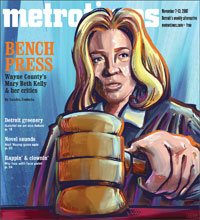
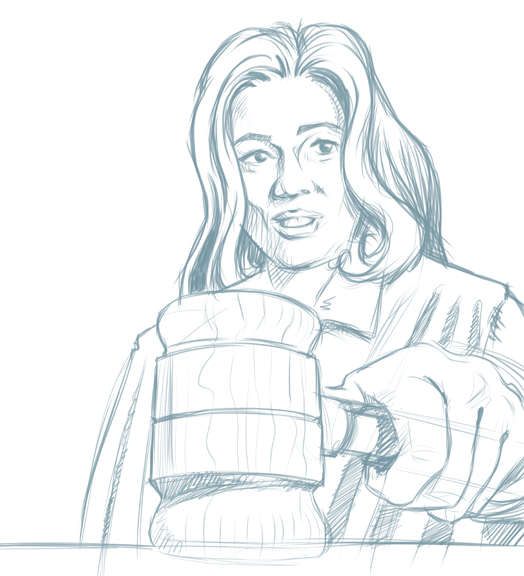
Local alternative paper Graphics Editor and Dr. Sketchy Ring Master Sean Bieri asked me to do up a cover for this week's edition of the Metro Times. The story's about the Wayne County Chief Circuit Court Judge and how she's made some rather controversial decisions. The assignment was a little short notice, but with my handy new Motion Computing LE1600 I was able to whip out a cover in two days. Not sure that my caustic color combination would fly, I did a more tamed down version that didn't have green hair. Good thing too, because that's the one they went with.


Here's a look at the sketch, inked drawing, and original color version I did. All done digitally. Ain't technology grand?

Thursday, November 1, 2007

Post All Hallows Eve

Yesterday the Hallowe'en trick-or-treaters still managed to find me even though I took refuge at Cafe 1923 for my weekly cartooning night. Here's a portrait of my favorite in all of her Victorian Era finery.

Wednesday, October 31, 2007

Halloween is waning...

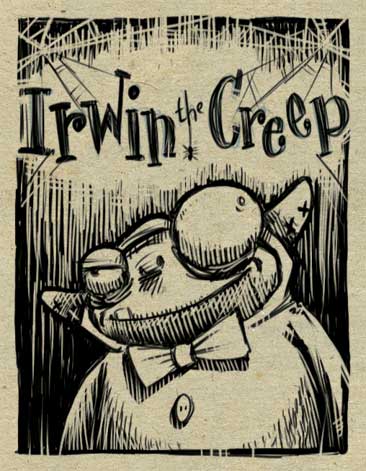
It's 9:30 pm and I think it's safe to go home and put the lights on again. The last of the trick-or-treaters (if in fact there were any) are down in their dungeons and sorting their stash. Nope, I didn't give out candy this year. Halloween has come and gone and Irwin the Creep failed once again to make an appearance. But that's okay! Because NEXT YEAR when he does I'll be ready.

I've got people working on plans as I type. Or at least I've got a co-worker in another state who has offered to help as payment for some monkeys. So to make up for not having Irwin entertaining the little hellions, I started a short mini-comic about his life and times to give away as a freebie next year. Here's a few pages as a year-ahead-of-time preview.

Monday, October 29, 2007

Halloween's a bit Sketchy

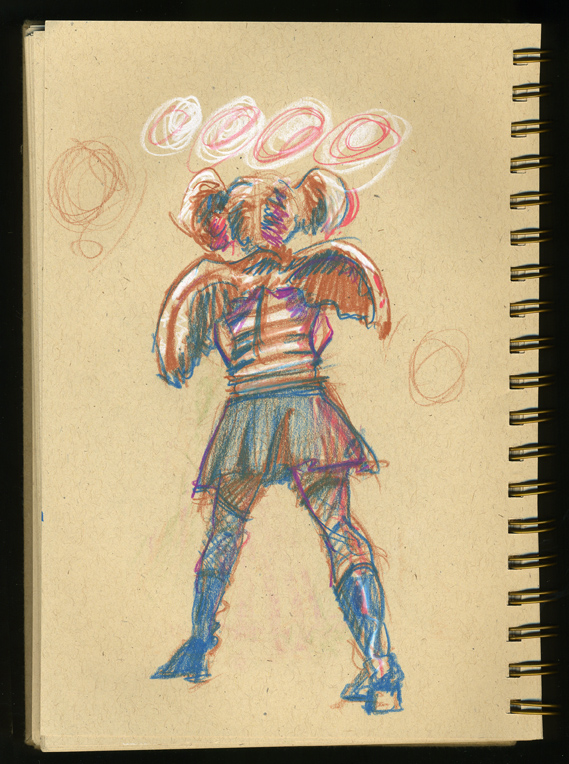
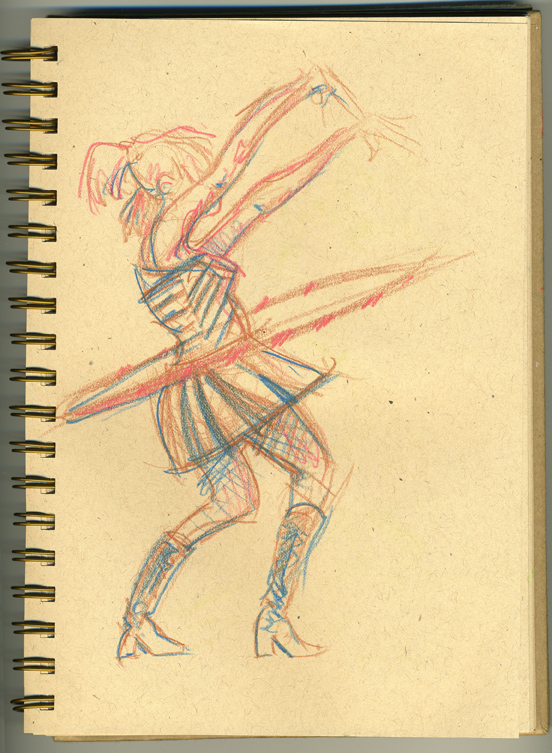
Last week was a special haunted version of Dr. Sketchy. Our models were the Motor City Rah-Rahs, cheerleaders for the Detroit Derby Girls roller derby team. Hula hoops were in full gyration as the Rah-Rahs decomposed throughout the evening. Lookit those evil eyes. Apparently they were possessed.


Oh, and I finally got the Dr. Sketchy stickers made. I guess there was a lot of calls for t-shirts too, so we'll have to check in with the good people at J's Silkscreens (where I worked while in college).


Here's the usual selection of sketchy-art, including the final pose where all I could see was the bottom of Suzanne Baumann's shoe.