Monday, January 14, 2008
Saturday, December 29, 2007
Santa Claus is Comin' to Sketchy
Thursday, December 20, 2007
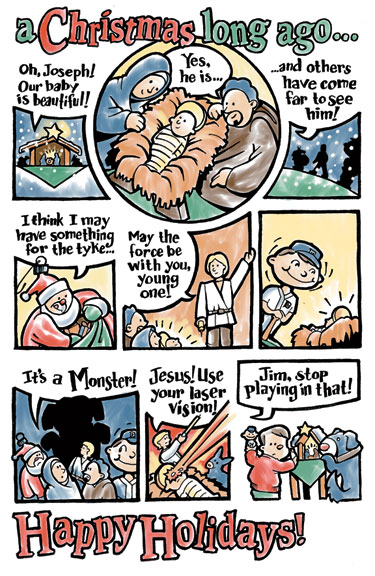
Cards of Christmas Past
Wednesday, December 19, 2007
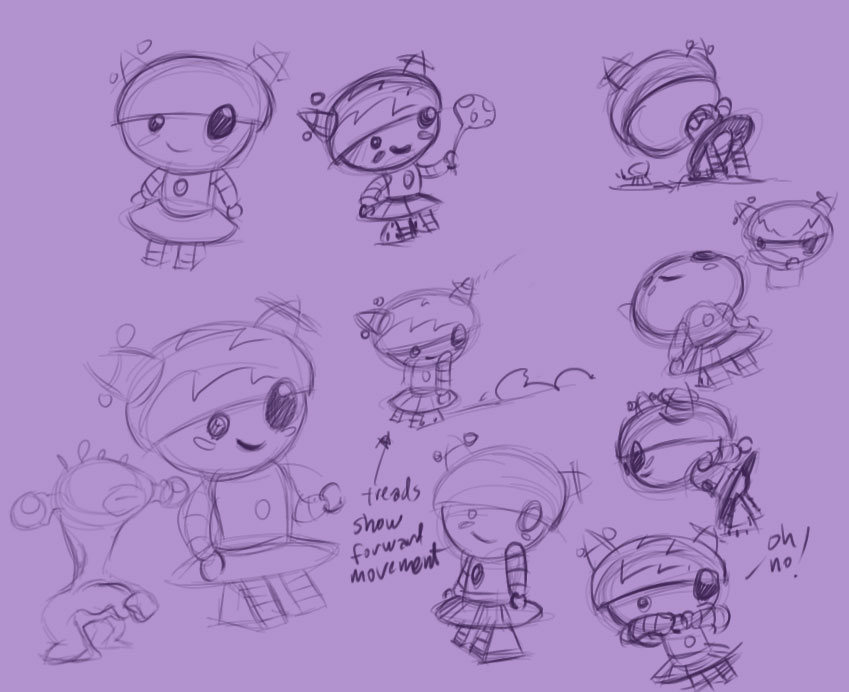
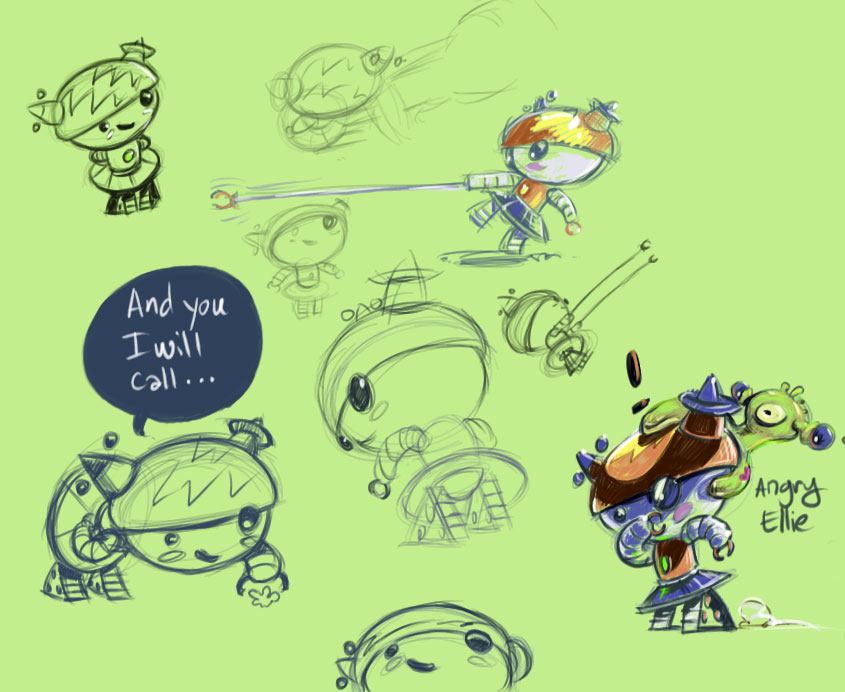
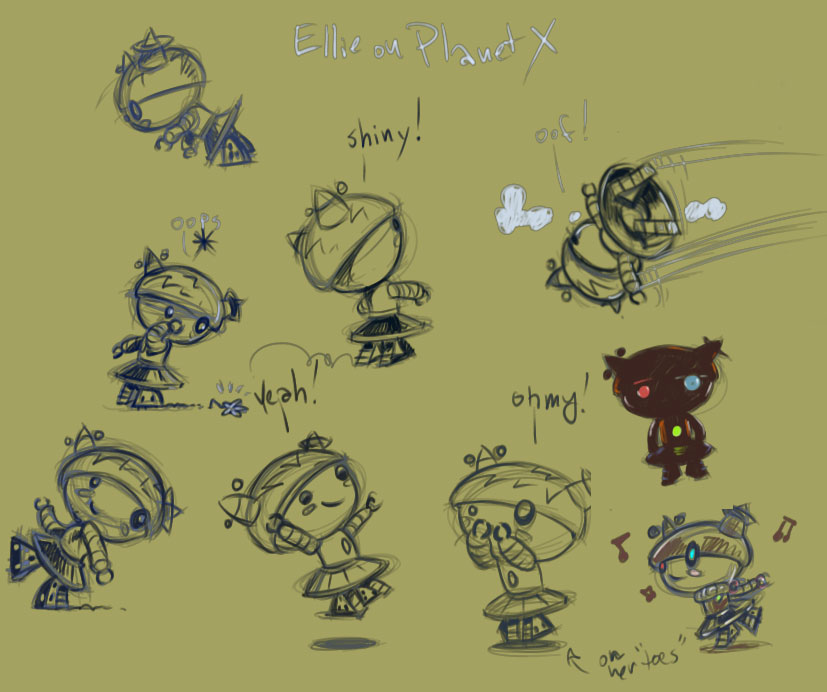
Ellie, Ellie, Ellie, and Ellie
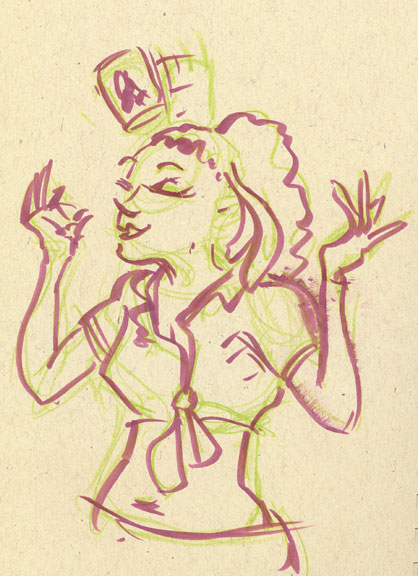
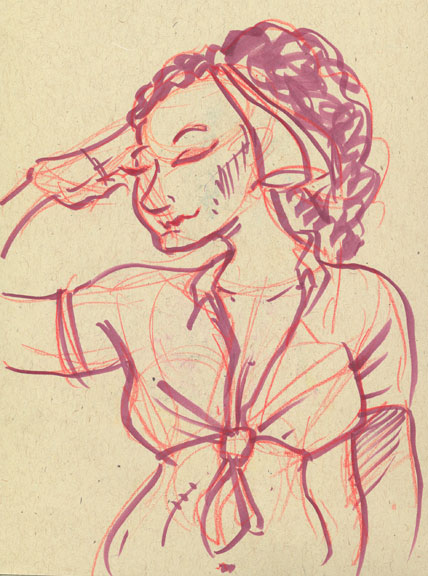
Much of the experimenting has helped flesh some things out in the story a bit more and helped me come up with new and interesting ideas (to me anyway). Also, practice makes perfect, and drawing Ellie over and over again in different poses helps get her looking consistent. A fun little exercise has been figuring out how to show the emotions of a robot that has a permanent smile using shadows on her face and reflections in her eyes. Here's some sketches:
Wednesday, December 12, 2007
Monday, December 10, 2007
X-mas Melancholia
Monday, December 3, 2007
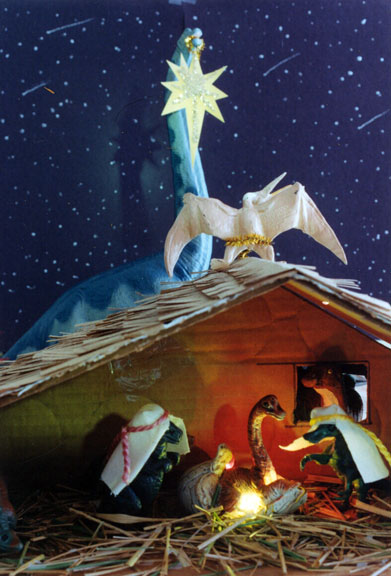
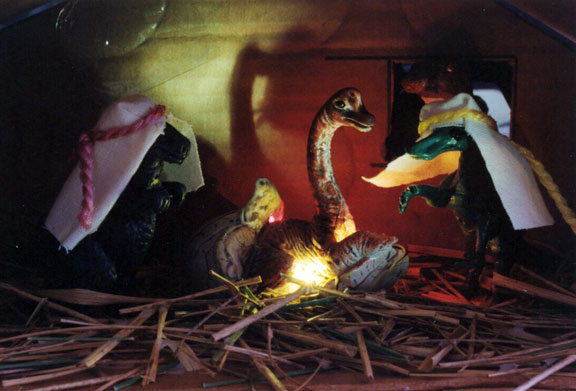
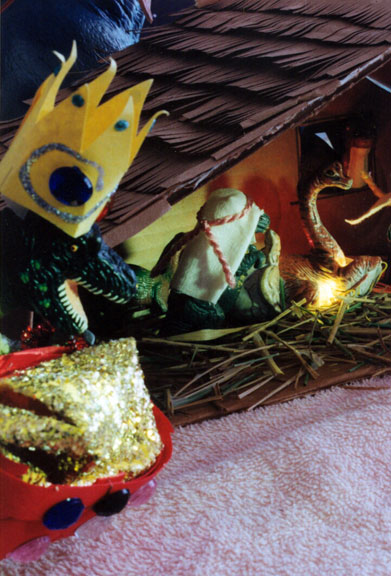
It's a Cretaceous Christmas!
All of this would be fine except that I shared my tiny workspace with someone who worked on the night shift. And if said person wasn't too keen on a herd of hadrosaurs migrating across the top of our mutual monitor, I might come in one day to find them all permanently gone. But such was not exactly the case as a note left by Erica, my night shift space-mate, would attest to. Yes, my dinosaurs had been taken, but they were safe and would be returned before our Christmas break.
Weeks passed and I wondered where my toys had gone when, only days before the celebration of the virgin birth, my dinosaurs arrived to usher in the holiday properly! These pics of Erica's handicraft are probably thirteen or fourteen years old, and I've always meant to do something with them. So, at last, here they are! The baby Jesus is being played by a brachiasaurus hatching out of its shell. Clever!
Sunday, December 2, 2007
Noel Night Out
Saturday, December 1, 2007
Thursday, November 29, 2007
More experimentin'
Tuesday, November 27, 2007
Back to makin' Art
Thursday, November 22, 2007
Art? Part X: The End of Art?
Over the several parts of this essay I’ve tried to explain just what I thought this grouping of “things” is that we create which is each artist’s view of how they look at their world. That I’ve dubbed it Art is only convenient for me to communicate my idea to you.
As we saw in the last installment though, there are times when we can’t be sure if something is Art even if were looking at it. We have to know the artist’s intentions and we don’t always know them. The water gets all muddy and suddenly we’re not even sure what’s real or imaginary, if Keanu Reaves is actually living in a virtual world on our computer, or if there’s even a point to it all. Now what?
Where’d Art Go?
There are times when, in my head, Art enters into some kind of Twilight Zone. Like physics, when we start looking too close, rules start to break down and stuff gets all weird and junk. Up is down, left is right, Madonna is in the Rock and Roll Hall of Fame, Art is Craft. And weirdest of all is when there seems to be no art at all when it should be right there before our eyes (or ears).
Take, for example, music. A composer has in mind an idea for a symphony. She writes down some notes while plinking them out on her piano and comes to some conclusion of how the piece is to sound. She then conducts an orchestra who plays it for an audience that cheers wildly and asks for an encore. But...where’s the art?
Is it in the music we hear? No, because the music is played with the intention that it is an exact copy of the symphony perceived by the composer. In the notes then? No, the notes are merely instructions for the musicians to follow to a tee. And, of course, any subsequent playing of the symphony is another copy, as well as any recording of it.
Or how about photography? Is the art in the moment the photographer snaps the shutter? In the negative in the darkroom? Surely these are both only steps in the process to get to the final art: the photo. But what if the intent is to make multiple prints with the idea that they are all identical? These are then copies – Craft. Again, where did the art go? Printmaking works in a similar way.
What if I create an illustration for a children’s book? I suppose that the single painting could stand alone as a work of Art. But if my intentions are that it is only complete when the illustration, along with all of its other illustration buddies, are paired up with the text, printed and bound into multiple copies of books...where’s the final art? Is it in the finished books? Isn’t this just the same as the print and the photo?
It would seem at times that Art is intangible. Even when we view van Gogh’s Sunflowers we aren’t seeing it as it appeared immediately after he painted it. The paint has dried and cracked. Maybe it’s even faded or acquired a layer of dust. We don’t see it as he intended it and cutting part of our ear off won't help. Like a song that lasts for only a brief time, Sunflowers too will disappear when the Sun expands into a red giant and chars everything on the planet to a cinder.
Sunflowers, Vincent van Gogh, 1888
Is it ever even possible to experience Art exactly as the artist intended it, anyway? Nope. We all have a lot in common but whenever Art is perceived by someone other than the artist it loses something in the translation. The only way we could fully experience what the artist means is if we share that experience, and we can’t do that yet. But that’s the one thing that all of these creative endeavors have in common. All of these interpretations of universes have an artistic experience associated with them. If we have something tangible to enjoy that we can call Art, well, that’s a bonus.
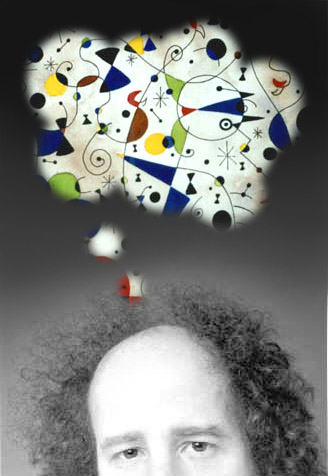
If we take it one step further, maybe we can have artistic experiences without even producing anything. Comedian Steven Wright had an interesting perspective when he said he was making some abstract Art. “Really abstract. No paint. No brush. I’m just thinking about it.”
Weird, indeed.
The Essential Unessential
When I came up with a definition of Art, it wasn’t worded the way that the elegant version used in this essay is. Mine stated that Art was anything that someone made that was more than its utilitarian purpose without being a copy. (Now you know why I went with the other version.) One thing that I tried to make clear is that, because Art had no utilitarian purpose, it was therefore “useless”.
My choice of words was wrong though, because useless isn’t really accurate for describing what Art is. My good friend Scott McKeeve recently suggested that Art is the one thing we create that is actually “unessential”. We don’t need it to survive. Using fancy sporks isn’t going to feed us any better than regular sporks. But Scott also pointed out that when Art is taken away it affects us in negative ways. Look at the architecture from Soviet era Russia and it just depresses the soul. When the new high-rises that are going up in my native Royal Oak are pointed out, sighs are heard along with statements proclaiming how they look like prisons. Art matters.
In the movie Dead Poet’s Society, Robin Williams plays an unconventional professor of literature. He asks a member of his class to read from the introduction of a book on poetry which tells how we can rate a poem’s goodness on some sort of scale. He then instructs everyone to tear out that section and throw it away. Once they all comply, he has them gather close around. He explains to them in so many words that, although being mathematicians and engineers are all noble pursuits, it is Art for which we do all of these things. A world without art is an empty place.
My dissection of art really is a pointless exercise. It would be better if we just go out and appreciate art for what it means to us. Better yet, go and make your own. And don’t worry if you think it’s not as good as someone else’s. All that’s important is that you like it.
Art? Part IX: Dick Blick vs. Michael's
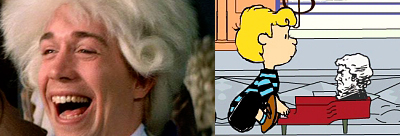
Way back when I was involved in that now infamous internet Art chat, one of the other members who went by the name Johnny Rotten brought up an interesting point. During the period of time when Mozart and Beethoven were burning up the charts with such ditties as Clarinet Concerto in A major and Piano Sonata No. 8 in C minor, there was a widely acceptable practice termed “Theme and Variation”. To take an existing melody and vary it to the new composer’s ideas was a perfectly acceptable practice. It wasn’t considered plagiarism at all. And because these “craftsmen” were appending these tunes for King and Country, they would have balked at considering themselves artists. But would they have been correct?
Mozart could call himself anything he wanted, and if he wanted to say he wasn’t an artist, well, good for him. Like I said, the meaning of the word Art, as well as artist, isn’t always clear in daily usage. But he’s dead, and he didn’t read the definition of Art I proposed in the beginning of this diatribe. Was Mozart creating an interpretation of Mozart’s own universe? Surely not, if he was just swiping from someone else, right?
The answer to the question at hand lies in the word “variation”. Mozart didn’t just grab some melody that was floating in the air and present it as his own. If that was all any of the classical composers did, then all of their music would have been indistinguishable. But Wolfie went one step further. He added a little bit of variation, a little bit of that Amadeus magic to those melodies and made them his own. The moment he made a conscious decision to purposely interpret the melody in a different way, he created Art. Ergo, he’s an artist - according to the definition.
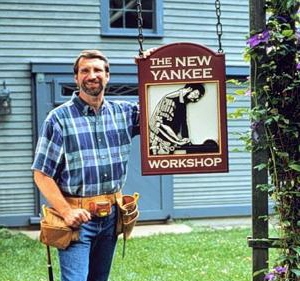
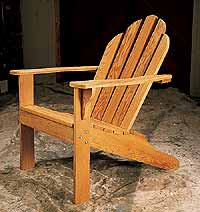
So, does that mean a craftsman is someone who just makes copies? Like when Norm Abram makes a copy of a chair in his New Yankee Workshop? Well, in a sense, yeah. If artists definitely are concerned with making interpretations of their universes, then craftsmen definitely are not. And if “Nahm’s” only interested in duplicating that Adirondack chair, then he’s not interpreting his universe. He’s copying someone else’s interpretation of their universe.
Let's say that Paul makes teapots. He makes really good ones that serve their purpose well, and that purpose is to hold my tea and keep it warm. And that might be the only purpose they serve. So his goal is to make sure that each teapot he constructs is as good as the ones that he’s made before. That is his intent. There is nothing about the teapot that would indicate he had any other intentions in mind. He has honed his craft at making a really good teapot. The teapot is a work of Craft.
Suddenly Paul gets it in his mind to make something new like this:
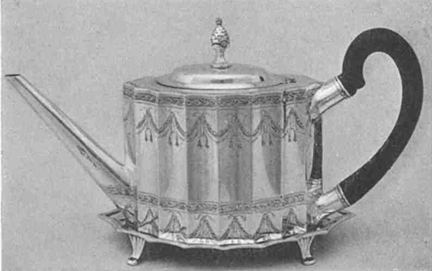
Until...
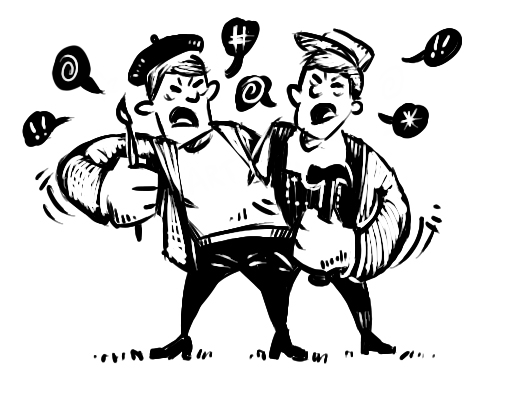
Mr. Revere starts making copies of his new teapot. Then the new ones are no longer works of Art. These are Crafts because the intention is to make these exactly like the fancy pot he previously made, but with no variation. The opposite of Mozart’s melody. Complicated, n’est-ce pas? It gets more convoluted. Because if Paul now decides to make each teapot a different color so that they are all unique, they’re back to being Art again. “What the #$*@!?”
Like Art, Craft is a rather ambiguous term when used in everyday conversation. When artist pooh-pooh Craft it’s because they generally have it in their mind unoriginal objects that are made for mass production, and cheaply so, with little thought going into them. But the definition gets really blurry, because what appears to be Craft can become Art under certain circumstances. And Art can also become Craft as well, as seen in the example of the new teapot copies. Or not-copies. Or whatever.
“So how the hell am I supposed to know if it’s Art or Craft or what?” You might never know. The guy who is in charge of painting all of the skies in identical production line starving artist paintings might throw in an extra cloud just to exercise his inner artist. Then it becomes Art. The only way we can really know for sure whether something is Art or Craft is by asking the person who made it. Only that person can tell us if it was their intention to make something that tells us the meaning behind what they perceive in their mind, or if they meant for it merely to be a copy of something else. And sometimes we never get any clue as to whether or not an object is a work of Art or of Craft. It’s funny, how everything just ends up depending on what the motives, the intentions, of the artist are.
When it comes down to it, the differences between the two are so esoteric when looking at them in reference to the definitions I’ve used. It becomes almost useless to try to identify which is which when you don’t have all the information at hand. Feh, just go with what feels right. If you show me a photo of a teapot in a book and tell me what a wonderful work of Art it is, I won’t correct you by saying that it’s actually a representation of Art and therefore a copy, and is really Craft. I’ll smile and nod because I’ll understand what you’re talking about.
Next time: The End of Art?